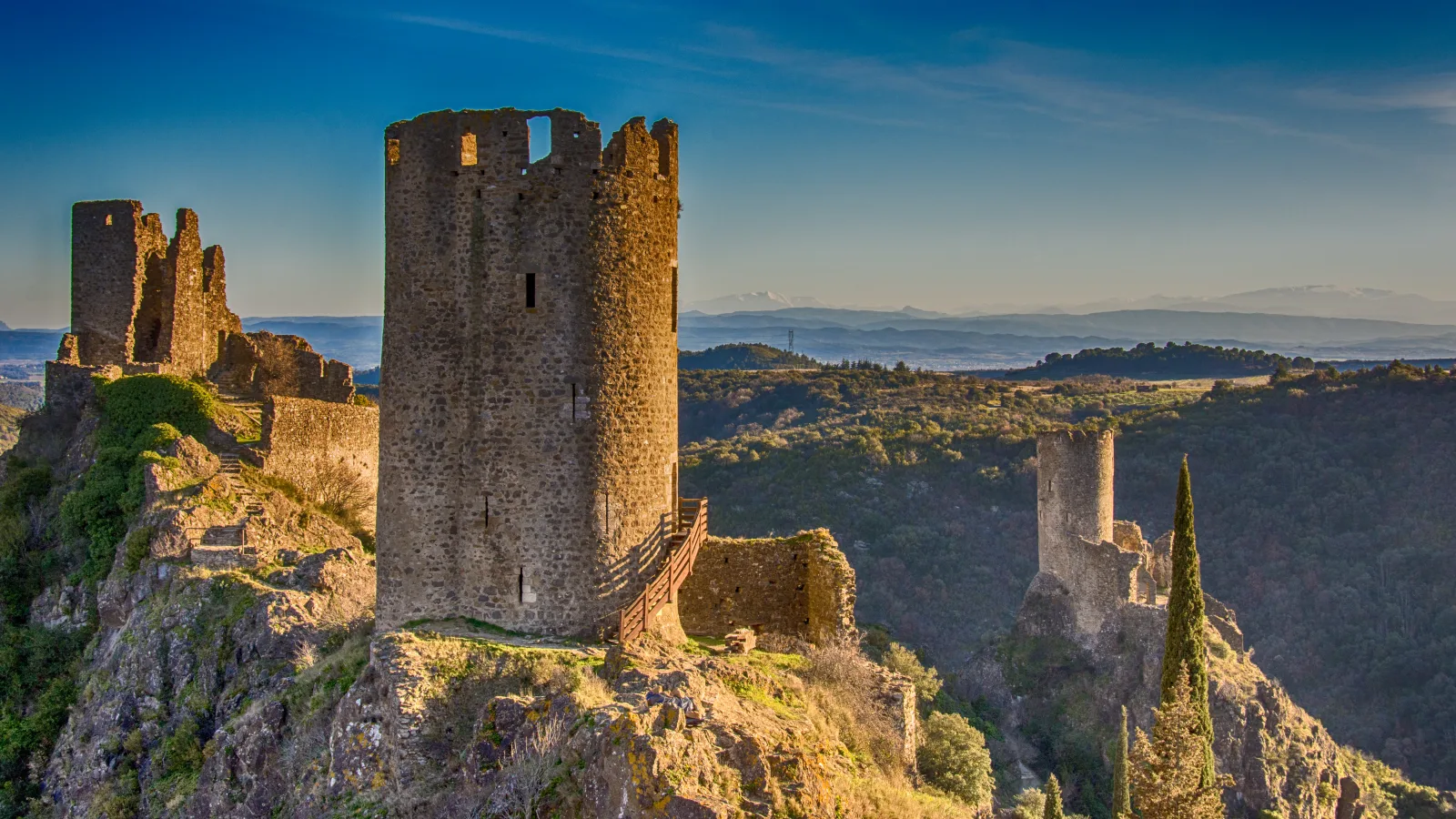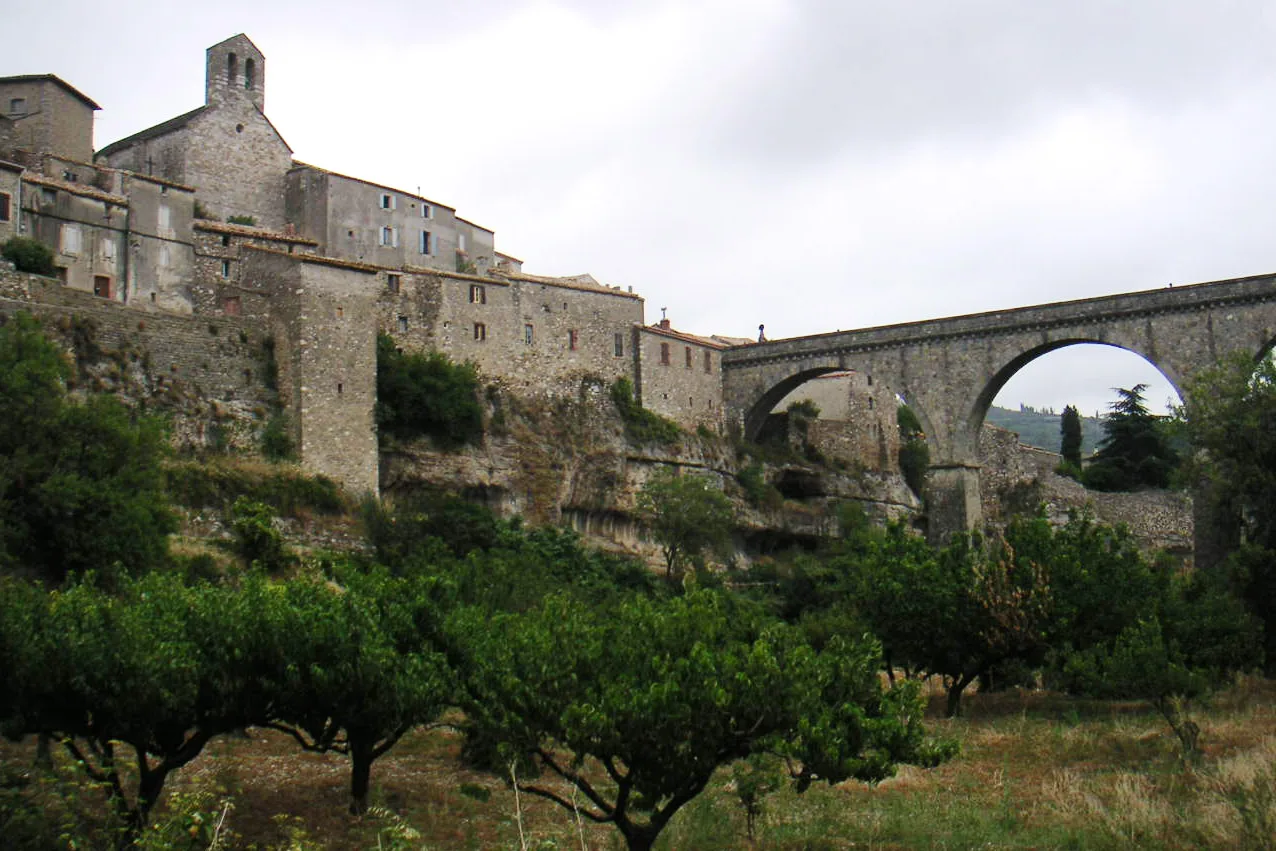
Minerve, a Cathar village lost in the gorges
Minerve sits on a limestone spur, wedged between two deep gorges. The Cesse and the Brian. Water has carved through the rock for millennia, leaving natural bridges beneath the village. It’s one of the “Most Beautiful Villages of France”, and also a place scarred by a terrible history.
From Florensac, it takes about an hour and a quarter to get there. It’s the longest day trip I recommend to our guests, but it earns every kilometre.
A setting that commands attention
You arrive along a road winding through the Minervois hills. The garrigue is dry, the vines low, the landscape increasingly mineral. Then you spot Minerve suddenly, round a bend. The village balances on the edge of a forty-metre drop. It stops you in your tracks.
To enter, you cross a bridge over the gorge. Below, nothing but white rock and the dry bed of the Cesse (except in winter, when the water returns). You understand immediately why the Cathars took refuge here. The place is a natural fortress.
Parking is at the top of the village. Free off-season, a few euros in summer. From there, five minutes on foot and you’re in the heart of the lanes.
The natural bridges
This is Minerve’s geological wonder. The Cesse river has punched through the limestone in two places, carving tunnels known as bridges. The Grand Pont is 250 metres long and 30 metres high. You can walk through it when the river is dry, which is most of the year (May to October, roughly).
The Petit Pont is smaller but equally surprising. Walking under those rock vaults, in the dry riverbed, with light filtering in from both ends, it stays cool even in the height of summer. The silence is total.
A marked trail leads down from the village and loops around both bridges in 30 to 45 minutes. The ground is rocky in places. Bring closed shoes.
The Cathar history
In 1210, Simon de Montfort and his crusaders besieged Minerve for seven weeks. The village held out thanks to its natural position and a well cut into the rock. De Montfort built a trebuchet (nicknamed “la Malvoisine”) to destroy the path leading to the well. Without water, Minerve surrendered.
On 22 July 1210, around 140 Cathar “perfects” who refused to renounce their faith were burned alive. It’s one of the most brutal episodes of the Albigensian Crusade.
A memorial stands in the centre of the village. The Hurepel Museum (small local museum, a few euros entry) traces the Cathar history and the siege of Minerve with a scale model. It’s measured and well documented. Outside, a replica 13th-century catapult gives a sense of the scale of the siege machines.
The village
Minerve is small. Genuinely small. Around a hundred permanent residents. The medieval lanes are well preserved. You pass under stone arches, between houses with blue and ochre shutters, Virginia creeper climbing the walls.
Worth seeing:
- The church of Saint-Étienne: Romanesque, 11th century. The altar is a 5th-century marble slab, one of the oldest in the Languedoc
- The Hurepel Museum: Cathar history, siege model. Open in season, a few euros
- The dove of peace: a bronze sculpture at the tip of the spur, facing the gorges
- The ramparts: sections remain. The view over the gorges from the village edge is dizzying
In summer, a few art galleries and craft workshops open in the lanes. Discreet, not overwhelming.
The Minervois wine country
Minerve is at the heart of the Minervois appellation. Vines cover the surrounding hills, planted on limestone and schist soils. My father was a winemaker in Florensac, and my brothers still are. They know the Minervois wines well. The reds are full-bodied, generous, and the prices stay reasonable (5 to 10 euros a bottle at the estate).
Several estates offer tastings on the road between Olonzac and Minerve. If you like wine, plan a stop on the way back. Our family has been growing vines in the Hérault for over two hundred years, so we have a natural soft spot for our neighbouring vineyards.
A few ideas around Minerve:
- Caunes-Minervois (20 min north-west): a village known for its red incarnat marble, used at Versailles. The Benedictine abbey is worth a visit
- The Canal du Midi (at Olonzac, 15 min): walk or cycle along the towpath
- The Cesse gorges downstream: a lunar landscape in summer when the riverbed is dry
Getting there from Florensac
Head towards Béziers, then take the D5 via Olonzac. The last stretch between Olonzac and Minerve winds through the Minervois vineyards. It’s narrow and winding in places, not ideal for a campervan.
Best to go in the morning to avoid the heat in the gorges. Bring water, a hat, and closed shoes for the natural bridges. In the afternoon, the gorges are in full sun and it gets very hot from June to September.
The ideal plan: leave in the morning, picnic on site or eat at La Cantine de Minerve (simple plates, book in summer), and head back in the late afternoon with a few bottles of Minervois in the boot.
Practical information
- Distance from Florensac: 80 km (1h15 by car)
- Parking: free off-season, paid in summer (a few euros)
- Natural bridges: free access, 30-45 min trail. Accessible when the river is dry (spring-summer-autumn). Closed shoes recommended
- Hurepel Museum: open in season, a few euros entry
- Church of Saint-Étienne: free access
- Classification: "Most Beautiful Villages of France"
- Tip: avoid weekends in high summer (very small village, fills up fast). Go on a weekday or off-season
Minerve is the trip I save for guests who have already seen Pézenas, Sète, and the Canal du Midi. It’s further, wilder, and the history stays with you. Our rooms make a good base for exploring all of the Hérault.